Upload Live Video Sound Directly to the Internet Ambooza
"Alive streaming: where exercise I even brainstorm?" Without having a basic agreement of how live streaming works, getting started tin exist intimidating.
If y'all want to:
- Start streaming using something more than just your webcam or smartphone
- Understand the fundamental components of online video streaming
- Larn the basics of alive streaming quickly
And then you've landed on the right page.
Leap to
What yous'll need to start live streaming:
- Video and sound source(s) – These are cameras, computer screens, and other image sources to be shown, likewise as microphones, mixer feeds, and other sounds to be played in the stream.
- A video encoder – This is the computer software or standalone hardware device that packages real-time video and sends it to the Internet.
- A streaming destination – The identify your alive video will become available online. Pop ones include YouTube, Vimeo, and Facebook Live.
- A stable Cyberspace connectedness – So your stream doesn't freeze, buffer, or drop off entirely.
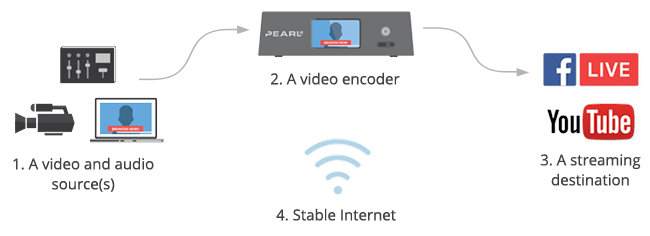
The basic setup and flow of a live stream
1. Video and audio sources
A stream of video information (from a camera, for example) for your live stream is chosen a video source. Respectively, a stream of audio information is an sound source. A elementary stream might consist of simply ane video and audio source, while a more circuitous ane may have two or more audio and video sources involved. Different combinations of video and audio sources are referred to as "scenes" or "layouts" (think full screen, moving picture-in-pic, or side-by-side layouts).
The video source(due south) for a alive stream may come from a:
- DSLR camera
- Camcorder
- Computer screen
- Webcam
- PTZ camera
- Telephone or tablet camera
For live streaming, yous practice non need to have a storage card in your camera.
Sound sources may come up from a lapel, handheld, or USB microphone, or from an audio file. If you lot run your microphone indicate through your camera, the audio will come up embedded in your video source, which means they will arrive together through one cable. This is a very common way to capture sound.
Always be mindful of the groundwork music in your live stream because online video platforms tin can monitor and flag copyrighted content. You may receive a copyright violation or even be banned from streaming.
Acquire more than nigh choosing a camera for live streaming:
Best cameras for live streaming for any upkeep (updated for 2022)
Read more
How to capture audio and video sources
In society to start streaming online, you will need to capture the indicate from your sound and video sources. About video sources today use HDMI™ or SDI outs for external connectedness. Both HDMI™ and SDI cables are able to carry embedded sound forth with video. If you are using a estimator with a software encoder to stream, then just connecting a camera to a computer using an HDMI™ or a SDI cable will non work. You will demand an intermediary device called a capture menu. A capture menu (like AV.io HD for case) connects to the camera on one side, and to the computer over USB on the other, capturing exactly what the camera "sees." Almost hardware encoders, on the other mitt, come up with internal capture cards, and so you lot can connect video sources directly. We will talk more about streaming software and hardware below.
If you are using a USB camera or microphone, however, you can expect to capture these signals by simply connecting them directly to a computer.
2. Video encoder
What is a video encoder and why do I need one?
An encoder "translates" the video signal for the Internet. An encoder is a slice of software that compresses and converts the incoming audio-video point into a digital, web-friendly format. You need an encoder because most video sources don't come up ready for live streaming: video cameras are made for recording large and beefy video files, not intended for streaming in existent time.
Types of encoders
Essentially, today you have the choice of going live from three types of encoding devices: mobile phone/tablet, a computer with streaming software installed, or a dedicated hardware encoder. While a mobile telephone may exist an all-in-one video source and encoding device, the live production capabilities offered by a mobile device are extremely limited. Allow'south focus on the encoding tools that are able to handle more professional live streams, with the ability to add multiple cameras and layouts.
Software encoders
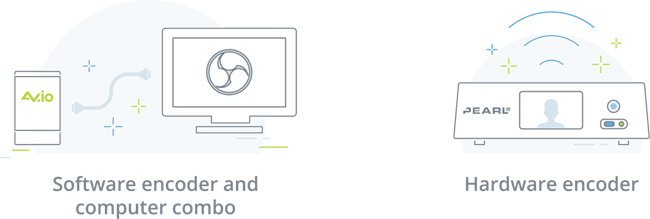
A software encoder is an installed application that uses your computer's resources (CPU) to neatly pack upwards the video and transport it online. Every bit previously mentioned, a capture card is necessary to capture the video signal from your source to your computer.
At that place is a wide diversity of free and paid streaming software available, including Wirecast, vMix, Streamlabs OBS, the ever-pop OBS Studio, and many more. You can learn all almost the differences between them in our best streaming software commodity. OBS Studio is a good way to commencement learning about encoding considering it'due south costless to download and install, all settings are easily accessible, and there are many online tutorials to help y'all along.
Information technology's important to remember that streaming software always takes a toll on the computer's CPU. This means that if your computer is non powerful enough to handle it, your viewers may experience buffering and dropped frames while you experience a very laggy computer. Nosotros recommend having a auto no lower than an Intel Core i5 two.8 GHz with 8GB memory for a proficient live streaming feel.
Hardware encoders
A hardware encoder (i.e., streaming hardware) is a dedicated device that handles all the encoding. Audio and video sources are connected direct to the hardware encoder, no capture cards required. Modernistic encoders are capable of taking in multiple video input formats, including HDMI™, SDI, VGA, and DVI, as well as XLR and 3.five mm analog audio. Naturally, hardware encoders need to exist continued to the network (via Ethernet, or Wi-Fi, or cellular) in order to stream.
Hardware encoders can come in different shapes, sizes, functionality, and toll points. Some are modest and portable, with the ability to have in only ane or 2 video sources (e.yard., Webcaster X2). Some are designed to be taken on the road: these use a bonded cellular signal for an Cyberspace connection. Examples include Teradek VidiU and LiveU encoders. Others are much more complex and powerful, able to take in many video and audio sources, record, mix, scale, and switch between them. For example, Epiphan'southward Pearl-2 and Pearl Mini are professional all-in-one alive production studios with incredibly vast functionality.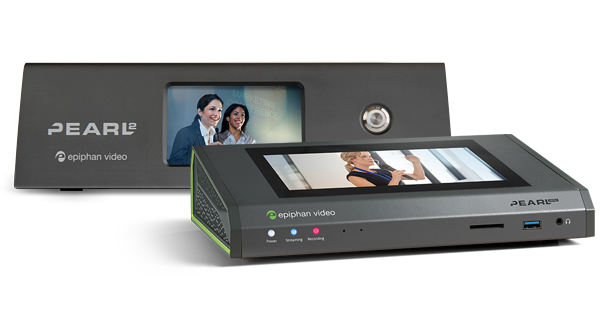
Pearl-2 and Pearl Mini, examples of hardware encoders
In many means, hardware encoders are more than convenient and reliable than using a personal computer with streaming software. Hardware encoders are specifically designed for live streaming. They also free up your calculator for other tasks.
Be sure to check out our streaming hardware vs software commodity if you want to learn more about choosing the right encoder for you.
Near of import encoder settings
Both software and hardware encoders have similar variable settings that bear upon your live stream. Here are the most important ones to know:
Frame rate: How many frames per 2nd are displayed, in frames per 2nd (fps). Common inputs:10fps (outrageously low, infuriating to the human being eye frame rate),24 fps,30 fps (standard for digital video),60 fps (beautiful and lifelike).
Output resolution: Size of video frame, width x height, in pixels.
Here are some common resolution names and their aliases:
| Resolution shorthand | Dimensions, in pixels | Also referred to every bit |
| 480p | 858×480 | SD or Standard Definition |
| 720p | 1280 x 720 | Hard disk drive or "HD Ready" |
| 1080p | 1920 x 1080 | FHD or "Full HD" |
| 1440p | 2560 x 1440 | QHD or Quad Hard disk resolution |
| 4K or 2160p | 3840 x 2160 | UHD or Ultra Hard disk drive resolution |
The virtually common resolution sizes used today are 720p and 1080p. These numbers refer to to number of pixels measured vertically. The "p" stands for "progressive scanning," and not for "pixel."
Bitrate: How much video information you are uploading, per second. Generally expressed in kilobits per 2nd (Kbps), although megabits per 2nd (Mbps) are also sometimes used. That's Kbps divided by roughly m.
General value range is g-8000 Kbps. Common values are one thousand Kbps (absolute minimum for live streaming) 2500 Kbps, 3000 Kbps, 5000 Kbps. This number depends on frame rate and resolution: the college the frame charge per unit and resolution, the higher the bitrate needs to exist for a shine, loftier-quality live stream.
Codec: Refers to the method of compressing (encoding) audio and video data for faster transmission. H.264 is the nigh common ane.
Keeping a fine balance between bitrate, frame charge per unit, and output resolution is what makes a practiced stream. How high you can go depends largely on the blazon of encoder you use and your Internet bandwidth. For example, with sufficient bandwidth, a hardware encoder like Pearl-2 is able to stream 1080p resolution at 60 fps without skipping a vanquish, whereas an older computer with streaming software may really struggle, dropping frames and causing buffering even with sufficient bandwidth.
3. Streaming destination
A streaming destination is the online site, platform, or app where your live video becomes bachelor to others. These destinations are more commonly referred to equally content delivery networks, or CDNs. Popular free CDNs include platforms like Youtube, Facebook Live, Twitch, and more than.
There are paid streaming platforms as well. These offer much more control over where and how your live stream is presented, who sees it, and whether and how the stream is monetized. CDNs like Vimeo, Vimeo Livestream, Dacast, StreamShark, and others offer different monthly plans. Costs depend on the amount of information in gigabytes you upload.
Gratuitous or paid, yous will need to sign up and log into the CDN of your pick. Some platforms (YouTube) require you to go through a few boosted steps and look for 24 hours earlier you can start alive streaming.
Choosing a CDN (streaming destination)
Naturally, each CDN caters to a specific audition. Equally soon every bit you figure out what you are live streaming and who your principal audience is, you can brainstorm choosing a plumbing fixtures CDN. Hither are some examples:
- Twitch is mainly for gaming. Twitch is costless to start, with additional tiers if you lot need them.
- Youtube (gratis) is for many things: personal, lifestyle, shows.
- Facebook (costless) is for connecting with your customs, sharing immediate news, as well as growing your brand.
- More specialized paid CDNs similar Dacast, StreamShark, and Vimeo Livestream are expert for large events such as concerts and sports.
- Special platforms like Streamingchurch.tv (paid) are intended for live streaming church building services and include many peripheral services.
Our advice would be to first with a complimentary CDN, effigy out all the ins and outs, and then move on to a paid i, if you need to. And so yes, you could potentially first live streaming for gratuitous right now! Be sure to check out this how to choose a CDN commodity for more detailed information about the differences between content delivery networks.
Set up up an event and fill out the description
A standard characteristic of an overwhelming bulk of CDNs is letting you decide between going live right now or scheduling to get live in the future. In either case, you will demand to fill out the live stream description, peradventure cull a category for your stream, and add together some tags. Using hashtags is a bang-up way to bring viewers to your stream.
4. Stable Cyberspace connectedness
Getting a steady network connexion is often the trickiest part of live streaming. We constitute that the almost reliable connection is a hardwired, defended Ethernet line. You tin can, of course, go live using Wi-Fi or cellular (4G/LTE) Internet, but these types of betoken tend to fluctuate.
Nosotros can't stress how important information technology is to perform a speed test beforehand. We recommend to always have approximately 1.5x your stream's bitrate bachelor to business relationship for these possible network fluctuations. For example, if your live stream has a scrap rate of 5 Mbps, then ensure you lot have at least 7.5 Mbpsupload bandwidth available to ensure a reliable live stream.
We become into much more than item about the required Internet bandwidth for live streaming in a split article. Exist sure to check it out.
How to live stream: five bones steps.
Substantially, the streaming setup workflow comes down to connecting your sources to the encoder, setting upwardly your scenes (layouts) for switching, configuring a few encoder and streaming destination settings, and establishing a connectedness between the encoder and the streaming destination. Naturally, streaming destination and encoder user interfaces will differ from example to example, just the basic workflow remains the same. In the example below, we chose to prove the Pearl-2 UI for the encoder and YouTube UI for the streaming destination.
Pace one. Connect your audio and video sources to the encoder.
Make sure everything has power. Pro tip: whenever possible, apply Air-conditioning power instead of battery power, for all and whatever device, especially a photographic camera. Placing your photographic camera on a tripod is always a good idea. Use a capture card if you lot are using your computer with encoding software. No capture menu necessary with hardware encoders like Pearl-2.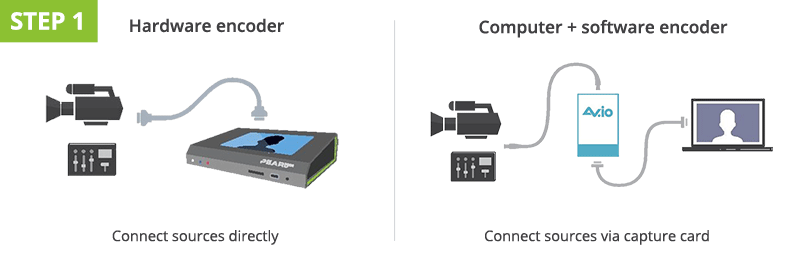
Step 2. Configure the encoder
If you program to do switching between a number of sources, go ahead and prepare your layouts (scenes). Then, configure the well-nigh of import streaming settings: resolution, frame rate, and bitrate. If you are unsure, get-go with 1280×720 resolution, thirty fps frame rate, and automated or 3000 Kbps bitrate. Everything else can pretty much be left at default. With software like OBS yous will exist configuring these settings in-app on your figurer. With a hardware encoder on the other hand, y'all volition need to access the device's settings via Web UI or via an app. Create a new RTMP Push stream.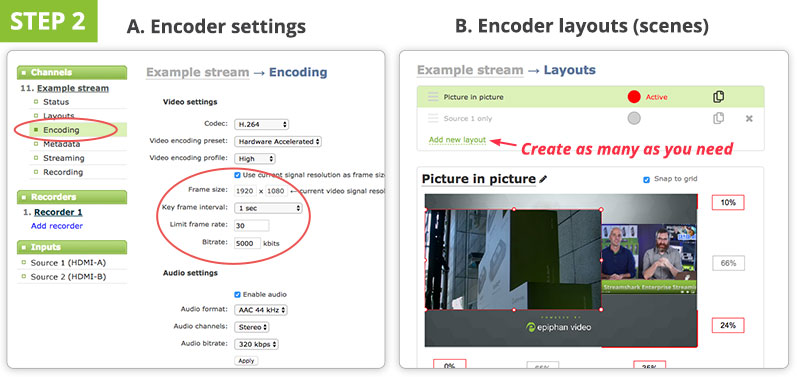
Step 3. Configure streaming destination settings
Log in to your live streaming platform (i.e., streaming destination, or CDN) and ready a new alive streaming event. Fill up out your stream description, configure privacy settings, etc.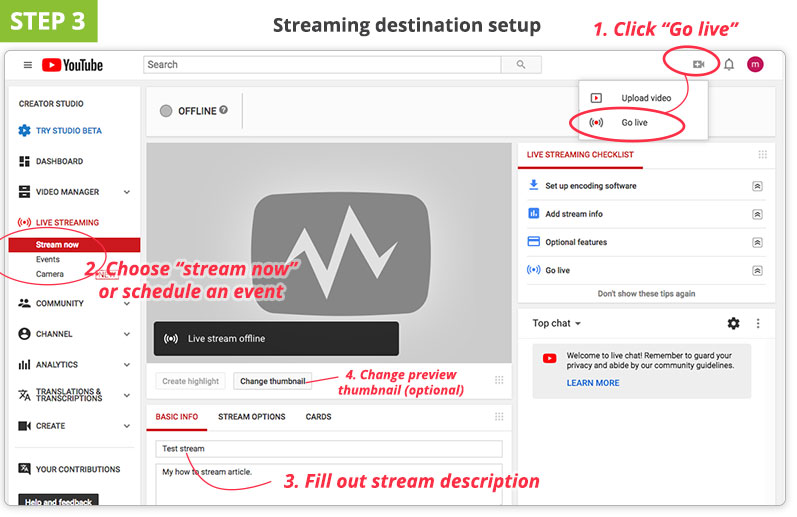
Footstep iv. Re-create and paste URL and stream fundamental from CDN into encoder
This is what actually ties your encoder and your streaming platform together. In order to know where to get video information, the CDN needs to verify and connect with the encoder, while the encoder needs to know where to send the data. This is done using a special password shared between the 2, called a stream name (or sometimes stream key). The stream name/fundamental is provided past the streaming platform (CDN). Keep this key safety, every bit those who know it may exist able to stream to your account.
The stream URL and central are commonly found in CDN's advanced or encoder settings sections. Copy the stream URL (looks like a web accost) and the stream key from the CDN into the respective fields in the encoder UI. You lot tin leave the username/password fields bare. Click "Save" or "Apply."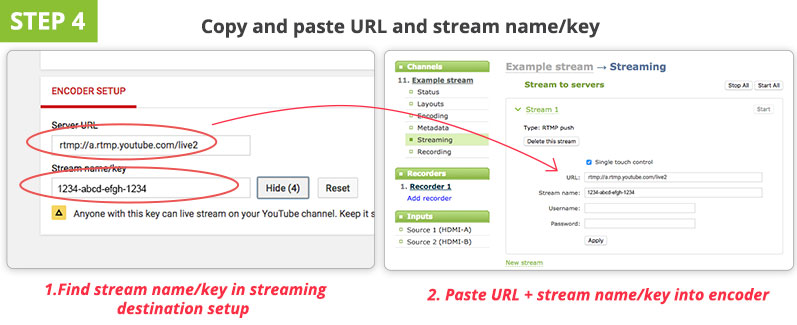
Step 5. Click "Showtime Streaming" on the encoder to go live
Once you press "outset streaming" somewhere in the encoder UI, your CDN preview window should tell you that it is receiving signal from the encoder. There is generally a lag of 10-thirty seconds between the encoder and the live stream on the CDN.
Control live switching from the encoder UI. Retrieve that you need to finish your stream also in the encoder UI.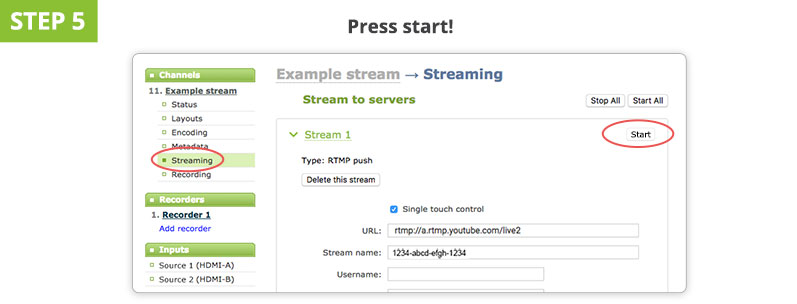
Pro tips
- Alive streaming requires lots of prep work. Checking that yous accept actress batteries, testing the connection speed, and checking the sound should exist office of every alive stream preparation process.
- Exam your alive stream on a dummy account/private channel first. You volition learn whether your bitrate is sufficient, how the picture looks, how you sound, and this will give you a run a risk to make tweaks.
- In that location are other of import elements for a great live stream, such as having a overnice set and good lighting. One time you lot've mastered all the basics, cheque out our alive streaming studio essentials article to larn how to accept information technology to the next level.
Be certain to check out our crawly best live streaming setups infographic. It'due south a great tool for visualizing the diverse streaming setups.
Conclusion
Live streaming is a very broad topic, and each streaming case is different. This mail service was intended to be a very general wait at how to go live. We do, however, hope we were able to provide some clarity nigh the fundamentals of going alive and how to first live streaming. Understanding these nuts along with some practice volition assistance make your live streams outstanding.
Source: https://www.epiphan.com/blog/how-to-live-stream-for-beginners/
0 Response to "Upload Live Video Sound Directly to the Internet Ambooza"
Post a Comment