Philip Guston Abstract Expressionism to Neoexpressionism The Art of America
| Philip Guston | |
|---|---|
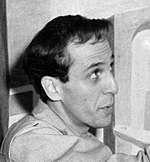 Guston at a mural in 1940. | |
| Born | Phillip Goldstein (1913-06-27)June 27, 1913 Montreal, Canada |
| Died | June 7, 1980(1980-06-07) (anile 66) Woodstock, New York, US |
| Nationality | American |
| Teaching | Los Angeles Transmission Arts Loftier School, Otis Fine art Establish |
| Known for | Painting, drawings, murals, prints |
| Style | Cartoon, Abstract |
| Motion | Abstract expressionism, Neoexpressionism, figurative painting, New York School |
| Spouse(south) | Musa McKim |
| Patron(due south) | David McKee |

Philip Guston (born Phillip Goldstein, June 27, 1913 – June vii, 1980), was a Canadian American painter, printmaker, muralist and draftsman. Early on in his five decade career, muralist David Siquieros described him as 1 of "the most promising painters in either the Us or Mexico,"[ane] in reference to his antifascist fresco The Struggle Against Terror, which "includes the hooded figures that became a lifelong symbol of bigotry for the artist."[2] "Guston worked in a number of artistic modes, from Renaissance-inspired figuration to formally accomplished abstraction,"[3] and is now regarded i of the "well-nigh of import, powerful, and influential American painters of the last 100 years."[iv] He also oft depicted racism, antisemitism, fascism and American identity, also as, specially in his after most cartoonish and mocking piece of work, the banality of evil. In 2013, Guston'southward painting To Fellini gear up an auction record at Christie'southward when it sold for $25.8 million.[5]
A founding effigy in the mid-century New York School movement, which established New York as the new center of the global art world, Guston's work appeared in the famed Ninth Street Show and in the avant-garde art periodical It is. A Mag for Abstruse Fine art. By the 1960s, Guston had renounced abstract expressionism, and helped pioneer a modified form of representational fine art known as neo-expressionism. "Calling American abstract art 'a prevarication' and 'a sham,' he pivoted to making paintings in a night, figurative manner, including satirical drawings of Richard Nixon" during the Vietnam War as well equally several paintings of hooded Klansmen,[6] which Guston explained this mode: "They are cocky-portraits … I perceive myself as being behind the hood … The thought of evil fascinated me … I almost tried to imagine that I was living with the Klan."[7] The paintings of Klan figures were set to be part of an international retrospective sponsored past the National Gallery of Art; the Tate Modern; the Museum of Fine Arts, Houston; and the Museum of Fine Arts, Boston in 2020, but in tardily September, the museums jointly postponed the exhibition until 2024 "until a time at which we remember that the powerful message of social and racial justice that is at the centre of Philip Guston'south work can be more clearly interpreted."[6] [8]
The announcement spurred an open letter, published online past The Brooklyn Rail, and signed by more than 2,000 artists.[ii] [9] It criticizes the postponement, and the museums' lack of backbone to display or attempt to interpret Guston's work, besides as the museums' own "history of prejudice." It calls Guston's KKK themes a timely catalyst for a "reckoning" with cultural and institutional white supremacy, and argues that'southward why the exhibition must proceed without delay.[nine] On October 28, 2020, the museums announced earlier exhibition dates starting in 2022.[10]
Biography [edit]
Early years [edit]
The child of Jewish parents who escaped persecution by immigrating to Canada from Odessa, Guston was born in Montreal in 1913, and moved to Los Angeles in 1919.[2] The family unit were aware of the regular Ku Klux Klan activities against Jews and Blacks and which took place across California.[11] In 1923, peradventure owing to persecution or the difficulty in securing income, his father hanged himself in the shed, and the young boy plant the body.[12]
Guston'south involvement in cartoon led his mother to enroll him in a correspondence class from the Cleveland Schoolhouse of Cartooning.[12] In 1927, at the historic period of xiv, Guston began painting, and enrolled in the Los Angeles Manual Arts High Schoolhouse where he met Jackson Pollock, who became a life-long friend.[2] The two studied under Frederick John de St. Vrain Schwankovsky and were introduced to European modern art, Eastern philosophy, theosophy and mystic literature. The pair later published a paper opposing the high school's accent on sports over art, which led to expulsions, although Pollock eventually returned and graduated.[13]
Autonomously from his loftier school pedagogy and a ane-year scholarship at the Otis Art Establish in Los Angeles,[2] which left him dissatisfied, Guston remained a largely self-taught artist, influenced, amid others by Italian painter Giorgio de Chirico, whom Guston repeatedly best-selling throughout his career. He died in 1980 at the historic period of 66, of a center set on, in Woodstock, New York.[13]
Work [edit]
Political murals [edit]
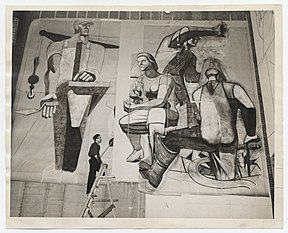
Guston sketching a mural for the WPA Federal Art Project in 1939.

Philip Guston painting another Federal Fine art Project landscape in 1940 (photograph past Sol Libsohn).
An early activist, in 1932, the 18-yr-quondam Guston produced an indoor mural with artist Reuben Kadish in an effort by the communist-affiliated John Reed Club of Los Angeles to fundraise money in support of the defendants in the Scottsboro Boys Trial, ix Blackness teenagers falsely accused of a rape in Alabama and sentenced to death."[2] The landscape was and then defaced by local law forces, organized into tearing anti-communist Red Squads.[2] The subsequent court ruling found no fault on the part of L.A. constabulary, even though irreversible impairment was sustained to many works of fine art.
In 1934, Philip Goldstein (as Guston was then known),[14] and creative person Reuben Kadish joined poet and friend Jules Langsner on a trip to Mexico, where they were commissioned to paint a 1,000-square-foot (93 m2) landscape on a wall in the onetime summer palace of the Emperor Maximilian in the state capital of Morelia. They produced the impressive The Struggle Against Terror, whose antifascist themes were clearly influenced by the work of David Siqueiros.[1] A ii-folio review in Time magazine quoted Siqueiros's description of them: "the nigh promising painters in either the US or Mexico."[1] In Mexico he also met and spent time with Frida Kahlo and husband Diego Rivera.[ citation needed ]
In 1934–35, Guston and Kadish also completed a mural that remains to this day at Urban center of Hope Medical Center, a tuberculosis hospital at the fourth dimension, located in Duarte, California.[ citation needed ]
WPA Murals [edit]
In September 1935, at 22 years of age, he moved to New York where he worked as an artist in the WPA program during the Great Low. In 1937, he married creative person and poet Musa McKim, whom he first met at Otis, and they collaborated on several WPA murals. During this period his piece of work included strong references to Renaissance painters such as Piero della Francesca, Paolo Uccello, Masaccio, and Giotto. He was also influenced by American Regionalists and Mexican mural painters.[3] In 1938 he painted a mail service office mural in the US post office in Commerce, Georgia, entitled Early Mail Service and the Construction of Railroads, and in 1944, he completed a mural for the Social Security building in Washington, D.C.[ commendation needed ]
Abstract expressionism [edit]

Zone, 1953–1954, oil on canvas, The Edward R. Broida Trust, Los Angeles

Cherries Three, 1976, oil on canvas, Honolulu Museum of Art
In the 1950s, Guston accomplished success and renown as a first-generation abstract expressionist,[xi] although he preferred the term New York School. During this menstruum his paintings oftentimes consisted of blocks and masses of gestural strokes and marks of color floating within the picture airplane as seen in his painting Zone, 1953–1954. These works, with marks oft grouped toward the heart of the limerick, remember the "plus and minus" compositions by Piet Mondrian or the late Nymphea canvases by Monet.
Guston used a relatively limited palette favoring blackness and white, grays, blues and reds. It was a palette that would remain axiomatic in his afterward work despite Guston's attempts to expand his palette and reintroduce abstraction to his piece of work, late in life, equally evidenced in some of his untitled work from 1980 that has more than blues and yellows.
Neoexpressionism [edit]
In 1967, Guston moved to Woodstock, New York. He was increasingly frustrated with brainchild and began painting representationally again, merely in a personal, cartoonish manner.[3] "It disappointed many when he returned to figuration with aplomb, painting mysterious images in which cartoonish-looking cups, heads, easels, and other visions were depicted against vacant biscuit backgrounds. People whispered behind his dorsum: "He's out of his listen, and this isn't art," curator Michael Auping said. "He could have ruined his reputation, and some people said he did."[three] The first exhibition of these new figurative paintings was held in 1970 at the Marlborough Gallery in New York. Information technology received scathing reviews from nearly of the art establishment.[3] Memorably, New York Times art critic Hilton Kramer ridiculed Guston's new style in an commodity entitled "A Mandarin Pretending to Be a Stumblebum",[15] referring to "mandarin" in the sense of an influential figure and "stumblebum" pregnant a clumsy person.[15] He chosen the act of changing styles an "illusion" and an "bamboozlement". The initial reaction of Robert Hughes, critic for Time magazine, who later changed his views, was put into a scathing review entitled "Ku Klux Komix".[xvi]
Co-ordinate to Musa Mayer's biography of her father in Night Studio, the painter Willem de Kooning was one of the few who instantly understood the importance of these paintings, telling Guston at the time that they were "about freedom."[17] Cherries Iii from 1976, held in the collection of the Honolulu Museum of Art, is an example of his belatedly fashion representational paintings. Although cherries are a mundane subject, their spiky stems tin exist a metaphor for the crudeness and brutality of modernistic life.[18]
As a outcome of the poor reception of his new figurative style, Guston isolated himself even more in Woodstock, far from the art world that had so utterly misunderstood his art.[eleven]
In 1960, at the summit of his activity every bit an abstractionist, Guston said, "There is something ridiculous and miserly in the myth we inherit from abstruse art. That painting is autonomous, pure and for itself, therefore nosotros habitually analyze its ingredients and ascertain its limits. Simply painting is 'impure'. It is the aligning of 'impurities' which forces its continuity. Nosotros are epitome-makers and epitome-ridden."[19] From 1968 onward, after moving away from abstraction, he created a dictionary of images such as Klansmen, light bulbs, shoes, cigarettes and clocks.[11] In late 2009, the McKee gallery, Guston'due south long-time dealer, mounted a bear witness revealing that dictionary in 49 small oil paintings on panel painted between 1969 and 1972 that had never been publicly displayed.
A catalogue raisonné of the artist's work was compiled by the Guston Foundation in 2013, congruent with contempo scholarly involvement that explored the periods he spent in Italian republic.[20]
Legacy [edit]
Public collections [edit]
- Fine art Found of Chicago
- Detroit Institute of Arts
- Honolulu Museum of Art,[eighteen]
- Metropolitan Museum of Art
- Museum of Modern Fine art (MoMA)
- Modern Fine art Museum of Fort Worth
- Governor Nelson A. Rockefeller Empire State Plaza Art Drove (Albany, NY)
- Tate Modern
Academic affiliations [edit]
Guston was a lecturer and instructor at a number of universities, and served as an creative person-in-residence at the School of Art and Art History at the Academy of Iowa[21] from 1941 to 1945. He then served an creative person-in-residence at the St. Louis Schoolhouse of Fine Arts at Washington University in St. Louis, Missouri until 1947. He connected with his teaching at New York University and at the Pratt Institute in Brooklyn and, from 1973 to 1978, he conducted a monthly graduate seminar at Boston University.[22]
Among Guston's students were two graduates of the University of Iowa, painters Stephen Greene (1917–1999)[23] and Fridtjof Schroder (1917–1990),[24] as well equally Ken Kerslake (1930–2007), who attended the Pratt Institute. Rosemary Zwick was a student at Iowa.[25] Among those who attended his graduate seminars at Boston University were painter Gary Komarin (1951–)[26] and new media artist Christina McPhee (1954–).[27]
He was also posthumously elected to the National University of Design as an Associate Academician.
2020 controversy [edit]
In the fall of 2020, Philip Guston Now, a long-planned traveling retrospective of Guston's piece of work, which included 24 of the Klan paintings,[half dozen] was postponed until 2024 by the traveling show'south four sponsoring institutions: the National Gallery of Art; the Tate Modern; the Museum of Fine Arts, Houston; and the Museum of Fine Arts, Boston.[28] [29] In a joint printing release issued by the museums, they wrote "The racial justice movement that started in the U.S. and radiated to countries around the world, in add-on to challenges of a global health crunch, have led us to pause," explaining that the international tour already rescheduled considering of the coronavirus was best delayed "until a time at which we recall that the powerful message of social and racial justice … can exist more clearly interpreted."[four] [8] Public response led to a "deluge of criticism from within the art world,"[half-dozen] as well equally major articles in New York mag, The New York Times, CNN, Artforum, Tablet, and The Wall Street Periodical, among other publications.
The near scathing response was collective, and organized in an open up letter, published online by The Brooklyn Rail. The letter featured a "listing of signatories [that] reads similar a roll call of the almost accomplished American artists alive: onetime and young, white and Black, local and expat, painters and otherwise," including Matthew Barney, Nicole Eisenman, Charles Gaines, Ellen Gallagher, Wade Guyton, Rachel Harrison, Joan Jonas, Julie Mehretu, Adrian Piper, Pope.Fifty, Martin Puryear, Amy Sillman, Lorna Simpson, Henry Taylor, and Christopher Williams."[29] Strongly criticizing the museums' lack of backbone to brandish the piece of work, endeavour to interpret it, or come to terms with the institutions' own "history of prejudice," the signers unanimously described the exhibition as a timely prompt for a "reckoning" — writing that's why information technology must continue as scheduled.[30] As of Oct 3, 2020, more than than ii,000 artists[2] had signed the letter, simply the exhibition organizers did not respond until they rescheduled the exhibition for dates beginning in 2022.[10] Philip Guston At present opened at the Museum of Fine Arts in Boston on May 1, 2022.[31]
Popular culture [edit]
In "Cat and Girl versus Contemporary Art," part of the Cat and Girl webcomic series, author Dorothy Gambrell critiques the difficulty and purpose of finding the meaning behind art using Guston's iconic Caput and Canteen painting.[32]
Auction record [edit]
In May 2013, Christie'due south set an auction record for the creative person'south work To Fellini, which sold for The states$25.viii million.[5]
See also [edit]
- Boston Expressionism
- Max Beckmann
- Scarlet Grooms
- Claes Oldenburg
- Jean Dubuffet
References [edit]
- ^ a b c Boime, Al (2008). "Breaking Open the Wall: The Morelia Landscape of Guston, Kadish and Langsner". The Burlington Magazine. 150 (1264): 452–459. JSTOR 40479800.
- ^ a b c d due east f g h Schwendener, Martha (October ii, 2020). "Why Philip Guston Tin can Still Provoke Such Furor, and Passion". New York Times.
- ^ a b c d e Greenberger, Alex (September thirty, 2020). "Philip Guston's KKK Paintings: Why an Abstract Painter Returned to Figuration to Face up Racism". Artnews.
- ^ a b Saltz, Jerry (Oct 1, 2020). "four Museums Decided This Work Shouldn't Be Shown. They're Both Right and Wrong. Fear postponed a Philip Guston retrospective. A reckoning must follow". New York Magazine.
- ^ a b "AUCTION RESULTS: CHRISTIE'S CONTEMPORARY EVENING Sale". Artobserved. May xvi, 2013.
- ^ a b c d Jacobs, Julia and Jason Farago (Sep 25, 2020). "Delay of Philip Guston Retrospective Divides the Fine art World". New York Times.
- ^ "Sense or censorship? Row over Klan images in Tate's postponed testify". the Guardian. 2020-09-27. Retrieved 2020-ten-04 .
- ^ a b "Philip Guston Now". world wide web.nga.gov . Retrieved 2020-x-03 .
- ^ a b "Open Letter: On Philip Guston At present". Google Docs . Retrieved 2020-10-03 .
- ^ a b "Postponed Philip Guston Retrospective to Open up in 2022". Artforum. November 6, 2020.
- ^ a b c d Marmer, Jake (Oct ii, 2020). "The Creative person Formerly Known as Guston". Tablet.
- ^ a b "Philip Guston". 2015-05-09. Retrieved 2016-09-fourteen .
- ^ a b "Philip Guston | Smithsonian American Art Museum". americanart.si.edu . Retrieved 2020-10-04 .
- ^ Aaron Rosen, Imagining Jewish Art: Encounters with the Masters in Chagall, Guston, and Kitaj (MHRA, 2009; ISBN 1906540543), p. 50: "In the mid-1930s the artist began, off and on, to use the surname 'Guston' in place of his inherited name of 'Goldstein'".
- ^ a b Kramer, Hilton (25 October 1970). "A Mandarin Pretending To Be A Stumblebum". The New York Times.
- ^ Hughes, Robert (9 Nov 1970). "Art: Ku Klux Komix". Time – via content.time.com.
- ^ Mayer, Musa, Dark Studio (Da Capo Printing, 1997), p. 157
- ^ a b Honolulu Museum of Art, wall label, Cherries III by Philip Guston, 1976, oil on canvass, accretion 7008.i
- ^ Balken, Debra Bricker; Philip, Guston; Berkson, Bill (1994). Philip Guston'due south verse form-pictures. University of Michigan: Addison Gallery of American Art. p. 34. ISBN978-1-879886-38-iv.
- ^ "Features – American Academy in Rome". www.aarome.org.
- ^ Brookman, Christopher from Grove Art online, http://www.moma.org/collection Accessed June 27, 2009
- ^ http://world wide web.themorgan.org/virtually/press.GustonChronology.pdf [ permanent expressionless link ] Accessed June 27, 2009
- ^ Smith, Roberta, "Stephen Greene, 82, 'Painter with Distinctive Abstract Mode'" Nov 29, 1999, Obituaries, The New York Times
- ^ Luther College Fine Fine art Collection, http://finearts.luther.edu/named_collections/schroder.html Accessed June 27, 2009
- ^ Jules Heller; Nancy G. Heller (19 Dec 2013). Northward American Women Artists of the Twentieth Century: A Biographical Dictionary. Routledge. ISBN978-1-135-63882-5.
- ^ Diehl, Carol, "Gary Komarin at Spanierman Gallery", May 2008, Art in America
- ^ "Archived copy". Archived from the original on 2009-06-29. Retrieved 2010-05-27 .
{{cite web}}: CS1 maint: archived copy as title (link) Accessed June 27, 2009 - ^ Holland, Oscar (October 1, 2020). "Artists slam decision to postpone exhibition of Philip Guston'due south KKK paintings". CNN.
- ^ a b Farago, Jason (Sep 30, 2020). "The Philip Guston Evidence Should Be Reinstated". New York Times.
- ^ The Brooklyn Runway. "Open up Letter: On Philip Guston At present". The Brooklyn Track'south Google Docs site for the publication of the open letter.
- ^ Whyte, Murray (May 1, 2022). "The MFA recast creative person Philip Guston amid a nationwide racial reckoning — here'south the result". The Boston Globe . Retrieved May ane, 2022.
- ^ "Cat and Girl » Archive » Cat and Girl versus Gimmicky Art". catandgirl.com . Retrieved 2017-10-28 .
Further reading [edit]
- Arnason, H. Harvard. Philip Guston. New York: Solomon R. Guggenheim Museum, 1962.
- Auping, Michael. Philip Guston: Retrospective (Thames & Hudson, 2006). ISBN 0-500-28422-9
- Botelho, Manuel. Guston em contexto: até ao regresso da figura. Lisbon: Livros Vendaval, 2007. ISBN 978-972-8984-05-2
- Bucklow, Christopher. What is in the Dwat. The Universe of Guston's Final Decade (The Wordsworth Trust, 2007) ISBN 978-1-905256-21-ane
- Burnett, Craig. Philip Guston: The Studio. (London and Cambridge, MA: Afterall Books / MIT Press, 2014)
- Coolidge, Clark. Inexplainable Means: Writings/Drawings (Stockbridge, MA: O-blek Editions, 1991).
- Corbett, William. Philip Guston's Late Work: A Memoir (Cambridge, MA: Zoland Books, 1994)
- Feld, Ross. Guston in Time: Remembering Philip Guston (Counterpoint Press, 2003) ISBN one-58243-284-eight
- Mayer, Musa. Night Studio: A Memoir of Philip Guston (originally published: New York: Knopf, 1988; new edition: Da Capo Printing, 1997) ISBN 0-306-80767-X
- Marika Herskovic, New York School Abstract Expressionists Artists Selection by Artists, (New York School Printing, 2000.) ISBN 0-9677994-0-6. p. xviii; p. 37; p. 170-173
- Marika Herskovic, American Abstruse Expressionism of the 1950s An Illustrated Survey, (New York Schoolhouse Press, 2003.) ISBN 0-9677994-1-4. p. 150-153
- Marika Herskovic, American Abstract and Figurative Expressionism Style Is Timely Art Is Timeless An Illustrated Survey With Artists' Statements, Artwork and Biographies. (New York Schoolhouse Press, 2009.) ISBN 978-0-9677994-2-1. p. 112-115; p. 136
- Dore Ashton, A Critical History of Philip Guston, 1976
- Yale University Art Gallery, Joanna Weber and Harry Cooper. Philip Guston, a New Alphabet, the Late Transition, 2000, ISBN 0-89467-085-9
- Robert Storr, Guston, Abbeville Press, Mod Masters, ISBN 0-89659-665-6, 1986
- David Kaufmann, Telling Stories: Philip Guston'south Afterward Works (Academy of California Printing, 2010) ISBN 978-0-520-26576-ix
- Peter Benson Miller, ed. Philip Guston, Roma ex. true cat. with texts by Peter Benson Miller, Dore Ashton, Musa McKim and Michael Semff (Hatje Cantz, 2010) ISBN 978-iii-7757-2632-0
- Peter Benson Miller, ed. Go Figure! New Perspectives on Guston, 2015 ISBN 9781590178782
- Michael Semff, 'An Unknown Lithograph from Philip Guston's Belatedly Work,' Print Quarterly, XXVIII, 2011, 462-64
- 'Philip Guston: Prints', Catalogue Raisonné, Text past Michael Semff, English, Sieveking Verlag 2015, ISBN 978-three-944874-xviii-0
- 'Philip Guston: Drawings for Poets', Foreword by Michael Krüger, Text past Bill Berkson, English, Sieveking Verlag 2015, ISBN 978-3-944874-19-seven
- Zaller, Robert (1998). "The tardily iconography of Philip Guston" (PDF). Apodemon Epos: Magazine of European Art Center (EUARCE) of Greece (5): four.
External links [edit]
- The Guston Foundation
- Philip Guston artwork at Brooke Alexander Gallery
- Works by Philip Guston and related exhibition records at the Museum of Modern Art in New York
- Biography of Philip Guston past Christopher Brookeman, Grove Fine art Online, 2007 Oxford Academy Printing
- Philip Guston at McKee Gallery at McKee Gallery, New York
- Philip Guston: A Life Lived (1982) – Picture about his life
- Conversations with Philip Guston – Flick by Michael Blackwood
Source: https://en.wikipedia.org/wiki/Philip_Guston
0 Response to "Philip Guston Abstract Expressionism to Neoexpressionism The Art of America"
Post a Comment